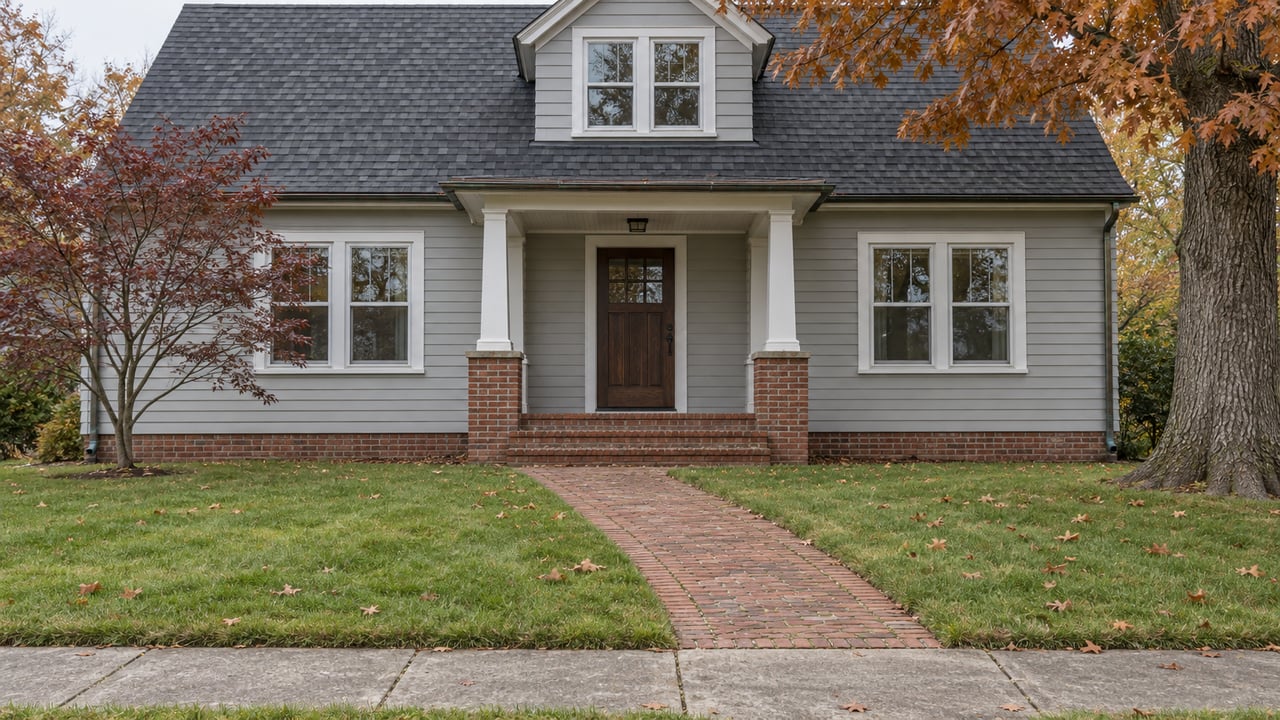
"If you plan to live in this home as your principal residence, you may qualify for the homestead property tax credit. The homestead property tax credit may significantly reduce the amount of property taxes you owe."
Maryland law requires that sentence in every residential sales contract, including every contract for a house in Anneslie. It reads like good news for a buyer, and over time it is. It leaves out something about timing, though. The credit already built into the seller's bill does not pass to you with the deed. For a while after closing, your bill is calculated without it.
On a house that changes hands often, that hardly matters. On a house in a 1920s neighborhood like Anneslie, where one owner may have held the property through several rounds of rising assessments, the annual tax shown on the listing can describe a bill you will never receive.
Where the listing's tax figure comes from
When a listing shows annual property taxes, it is showing the current owner's bill. That bill is the product of the owner's own history with the state.
Maryland's Homestead Property Tax Credit limits how much the taxable assessment on an owner-occupied principal residence can rise each year. The Maryland Department of Assessments and Taxation, known as SDAT, describes it as a credit rather than a cap on value. The department still sets a full market-value assessment, and the owner simply "pays no property tax on the market value increase which is above the limit." The state limit is 10 percent a year. Local governments can set a lower one, and Baltimore County's local cap for the 2026–2027 tax year is 4 percent.
The cap compounds on the owner's own taxable assessment from the year before. Under the state statute, each year's credit equals the current assessment minus the prior year's taxable assessment times the cap percentage, multiplied by the tax rate. So the longer someone owns a home while values climb faster than the cap, the wider the gap grows between what SDAT says the house is worth and what the owner is actually taxed on.
How fast Baltimore County outran a 4% cap
How much that gap matters depends on how quickly assessments have been rising, and in Baltimore County they have been rising fast. SDAT reassesses each property every three years and phases any increase in evenly over the following three years. In its January 1, 2026 reassessment report, SDAT recorded these three-year value changes for Baltimore County, residential and commercial combined:
| Reassessment | Group | Baltimore County change |
|---|---|---|
| January 1, 2023 | Group 2 | 16.4% |
| January 1, 2024 | Group 3 | 23.3% |
| January 1, 2025 | Group 1 | 22.6% |
| January 1, 2026 | Group 2 | 12.1% |
Spread a 22 or 23 percent increase over three years and each annual step is well above 4 percent. An owner with an approved homestead credit paid tax on only part of each step. The rest carries forward as untaxed value, year after year.
The pace has slowed. Group 2 residential values in Baltimore County rose 12.4 percent in the 2026 cycle. SDAT Director Bob Yeager told The Baltimore Banner that "after the rapid increases seen during the post-COVID recovery, this moderation is an important step toward balancing household wealth growth with housing affordability." A slower pace only slows how fast the gap grows. Whatever gap built up during the earlier rounds is still there, and a sale ends it.
The same assessment, billed twice
The statute is direct. The credit is granted for a taxable year "unless during the previous taxable year… the dwelling was transferred for consideration to new ownership." SDAT lists the same condition on its homestead page.
Here is a hypothetical house to show the effect. Every assessment figure below is invented. The rates and caps are the actual 2026–2027 figures for Baltimore County: $1.10 per $100 for the county, $0.112 per $100 for the state, a 4 percent county cap, and the state's 110 percent homestead percentage. Say the current phased-in assessment is $360,000, and the long-time owner's taxable assessment last year was $300,000.
| Hypothetical | Seller with homestead credit | Buyer in the year after closing |
|---|---|---|
| County taxable base | $312,000 | $360,000 |
| County tax at $1.10 | $3,432.00 | $3,960.00 |
| State taxable base | $330,000 | $360,000 |
| State tax at $0.112 | $369.60 | $403.20 |
| Annual total | $3,801.60 | $4,363.20 |
In this example, the listing shows a bill about $560 a year lower than the one the buyer will owe once the credit drops away. A larger gap between taxable and full assessment, which is what years of fast reassessments produce, makes that difference bigger.
Which July the difference arrives
Maryland's property tax year runs July 1 through June 30, and bills go out in July or August for the coming year. That calendar means the change shows up later than most buyers expect. For a buyer who closes in Anneslie this fall:
- At settlement: the bill for the current tax year was issued to the seller, with the seller's credit already applied. Your settlement attorney or title company handles how that year's taxes are divided.
- After the deed records: SDAT says it mails a homestead application to the new owner once the deed is recorded and its records are updated. Applications can also be filed online or on paper.
- The following July: because the house transferred during the previous taxable year, the new bill is calculated without the seller's credit.
- After that: once the new owner qualifies, the credit is calculated from the prior year's taxable assessment. The 4 percent limit then protects the new owner from that new, higher starting point. It does not bring back the seller's lower one.
Under the statute, the application must be filed by May 1 before the first tax year in which the credit applies. The owner must also actually live in the home by July 1 of that year. Baltimore County uses the same July 1 date for semiannual billing. Owner-occupants on record as of July 1 can pay in two installments: the first due July 1 and payable without penalty through September 30, the second due December 1 and payable through December 31.
The York Road comparison, with the reset included
Anneslie sits on York Road at the Baltimore City line, so a house here and a house a short walk south are taxed by different governments at very different rates. For 2026–2027, Baltimore City taxes real property at $2.248 per $100 and Baltimore County at $1.10, both on top of the state's $0.112. Both use a 4 percent local cap. The City labels its rates Fiscal 2027, and the County's tax rates page shows the same $1.10.
Apply both rates to the same hypothetical $360,000 assessment with no credit and you get about $4,363 a year on the county side and about $8,496 on the city side.
The homestead reset applies on both sides of the line. If you compare two listings by their posted tax figures, you are comparing two sellers' credit histories, and those can differ as much as the rates do. A fair comparison puts both houses on the same footing, using each property's full current assessment and its jurisdiction's rate.
Checking a specific house before you offer
The pieces you need for that comparison are public:
- Full assessment versus taxable figures. Look up the address in SDAT's Real Property database. SDAT notes that it shows the property's homestead status.
- Pending phase-in. Because increases phase in over three years, the assessment may still be rising toward a value SDAT already set. Reassessment notices are mailed in late December.
- The settlement packet. State law requires the settlement agent to give the buyer SDAT's homestead document, including the eligibility notice, online filing instructions and a paper application.
For a family selling a long-held Anneslie house as part of a downsizing move, the same rule applies in reverse. The credit can be claimed on only one dwelling, so the next home starts with its own application and its own taxable base. Talking about this openly with buyers keeps the listing's tax figure from becoming a surprise late in the process.
FAQ
Does the buyer's assessment reset to the purchase price? Not automatically. The assessment remains the one SDAT set, including any increase still phasing in. What ends at the sale is the seller's homestead credit history.
Will the homestead credit appear on my bill every year? SDAT says the credit applies only in years when the assessment rises more than the cap allows, so a year without it does not mean your approval has lapsed.
I missed the application deadline. Is the credit gone? The statute allows retroactive qualification for the prior year in some cases, with additional provisions for homeowners age 70 and older. Check the statute text and contact SDAT about your own situation.
This post is general information, not legal, tax or financial advice. Please confirm how these rules apply to your property with SDAT, a tax professional or your settlement attorney.
If you are planning to sell a home you have owned for a long time in Anneslie, or anywhere near the York Road line, The Hofmann Home Group can help you understand what your buyer's tax picture will look like before it comes up in negotiations. Start with a conversation and a current valuation: Get My Home Valuation.