By late August, the folding chairs on the porch of the Dumbarton House have seen most of a season's worth of use. The Rodgers Forge Community Association has kept its summer concert series going into this month, posting new dates on its site as recently as mid-August, the same rhythm that brought out the Mike Kuhl Organ Quartet for a free show under the trees in 2024, Buck N Grill parked out front serving from six o'clock on. It is a small ritual, dues-funded and calendar-scheduled, and it is only half the story of how this neighborhood actually spends its year.
The other half was never scheduled at all. It started with one string of Christmas lights strung across a street in November 2020, and it ended up on NPR. Understanding why both of these things are true, in the same thirty-eight blocks, tells you more about Rodgers Forge than either one does on its own.
The Calendar the Dues Pay For
The Rodgers Forge Community Association is not a homeowners association and dues are not mandatory, but the group still runs a full civic year on the money it collects. A membership drive each winter funds the things residents actually notice: the summer concert series at the Dumbarton House, an annual Dumpster Day for bulk trash at the elementary school parking lot, an Easter Egg Hunt, an annual picnic, and holiday visits from Santa. Board members, of whom there can be as many as twenty-three, are expected to serve on at least two committees or hold an office plus one committee, and to show up to a minimum of seven monthly meetings a year. The RFCA's own site lists an architecture committee that reviews exterior changes against covenants that run with the deeds, an external affairs committee that tracks county and state action, and a newsletter committee that keeps the whole operation visible to people who might otherwise never notice it.
Membership even comes with small, practical perks that have nothing to do with lawn signs or open houses. Ayd Hardware, which has served the neighborhood since 1974, gives RFCA members a discount on power washing, lawnmower maintenance, knife sharpening, and window screen repairs. It's the kind of benefit that only shows up on a members-only page, and it says something about what the association actually understands its job to be: not branding the neighborhood, but keeping the machinery of daily life a little cheaper and a little easier.
None of this is dramatic. It's infrastructure. And infrastructure, by design, doesn't generate national headlines.
What the Dumbarton Porch Is Actually Sitting On
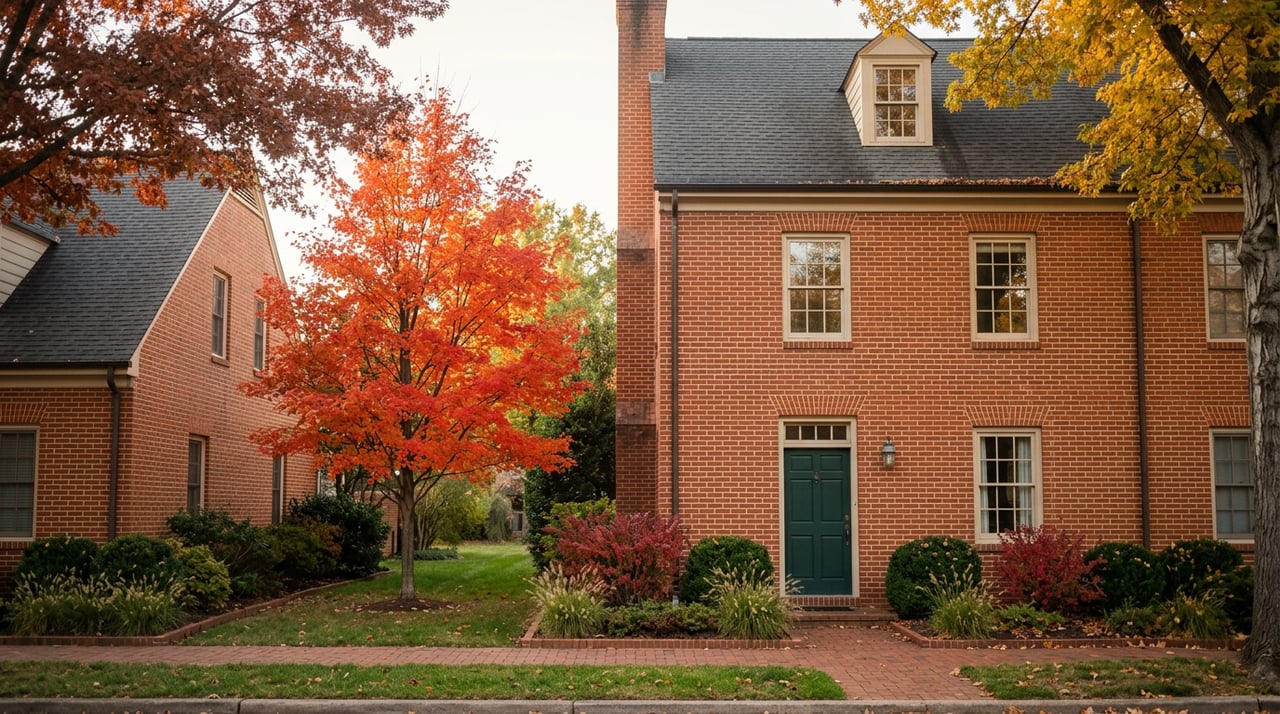
The Dumbarton House earns its spot on the concert bill because it predates the neighborhood by roughly a century. According to the RFCA's history page, the original house still stands on Dumbarton Green, tucked behind Dumbarton Middle School, on land that was once part of the two-hundred-acre Dumbarton Farm. The association's own account traces the farm's ownership back to the Hopkins family, though the historical record on exactly which Hopkins is thinner than the story implies. What's better documented is what happened to that land starting in 1924, when developer James Keelty began buying pieces of it to build what he called "group homes," a term he used deliberately to separate his product from the unbroken city rowhouse. Keelty built in clusters of four, five, or six houses at a time, each cluster designed a little differently from its neighbor, with grassy lawns and trees planted between the groups rather than packed wall to wall.
That decision, made nearly a century ago for aesthetic and marketing reasons, turns out to matter for a very different reason today. It's the reason a resident can run an extension cord out a window, string lights across a real gap of grass and street, and have it read as a gesture rather than an obstruction.
The Calendar Nobody Scheduled
In November 2020, a Rodgers Forge resident named Matt Riggs strung a single strand of white lights from his house to the house of his neighbor across the street, Kim Morton, who was struggling that year. He left a tin of cookies on her porch too. Riggs later described his thinking to NPR in an interview about what happened next: "I was reaching out to Kim to literally brighten her world." Morton's own account, published in the Baltimore Sun that December, described the moment as one small signal in a year that had taken a great deal from a lot of people.
What happened after that was not organized by anyone. Neighbors down the block saw the lights and asked to join in. Within weeks, strands were running from rooftop to rooftop and tree to tree across multiple blocks, with no committee, no dues, and no sign-up sheet. By the following year the display had grown enough that it made national news again, through The Washington Post, The Week, and Upworthy, and in the years since, the RFCA itself has caught up to what its own residents started, standing up a decorating committee and naming "Best Blocks" winners as the tradition grew too large to happen without some coordination behind it.
That sequence matters. The RFCA didn't invent the lights. It formalized something that was already working, months after it started, because the neighborhood's built form and its residents had already done the hard part.
Why the Two Calendars Need Each Other
It would be easy to read the concert series and the lights as two separate stories, one official and one spontaneous, and leave it there. But they depend on each other more than that framing suggests. The concert series exists because dues get collected, a committee books musicians, and an old farmhouse happens to still be standing with a porch worth sitting on. The lights exist because the physical grouping of the houses, with real yards and short block faces, makes an impulsive gesture between two neighbors visible to everyone else on the street within days. Take away either piece and the other looks smaller. A concert series without a community that already notices its neighbors is just a scheduled event. A spontaneous gesture in a neighborhood without walkable, closely grouped blocks stays private, one house talking to one house, never becoming a story any wire service picks up.
Rodgers Forge Elementary shows up in both calendars too, which is its own kind of evidence. It hosts the RFCA's annual meeting and board election, typically held in early October in the school cafeteria, and it's also where Dumpster Day sets up each spring. The building is civic infrastructure in the plain sense, but it's also just the place everyone already walks past, which is exactly why it works as a hub for both the planned and the unplanned versions of neighborhood life.
What's Coming Before the Year Turns Over
The concert series will likely wrap for the season within the next few weeks, and the RFCA's annual meeting and board election will follow in October, back at the elementary school cafeteria where residents can hear directly from the architecture, external affairs, and newsletter committees about the year ahead. Then, sometime after Thanksgiving, the lights will start going up again, one string at a time, on streets where nobody needs a committee's permission to remind a neighbor they're not alone.
Rodgers Forge doesn't advertise this rhythm because it doesn't need to. It shows up every year whether or not anyone writes it down. If you're already living inside those thirty-eight blocks, you've probably noticed both calendars without ever naming them as two separate things. If you're weighing whether a neighborhood like this fits how you actually want to live, that's the piece worth knowing before you look at a single listing.
If you're curious what a home in Rodgers Forge, or a rowhome anywhere else in the Towson area, is actually worth in today's market, The Hofmann Home Group knows these blocks well enough to give you a straight answer. Get My Home Valuation whenever you're ready to talk.